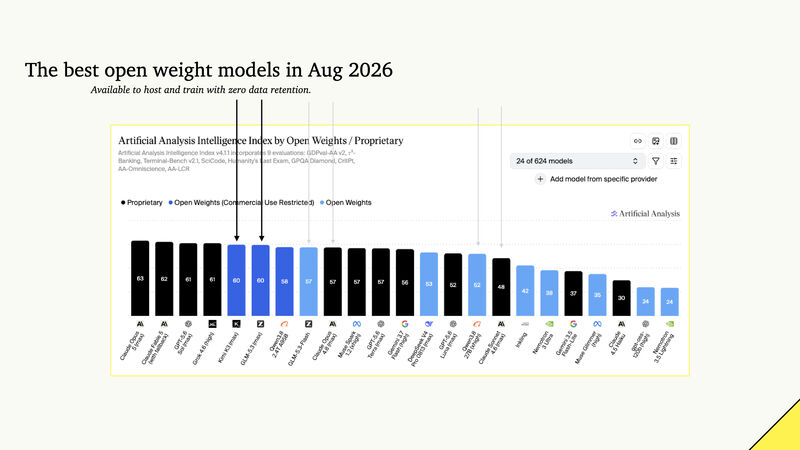
Made a few quick slides to explain this to a friend.
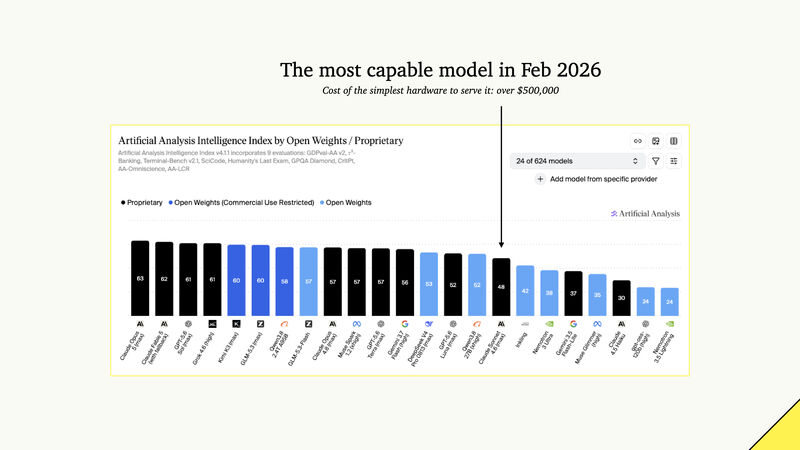
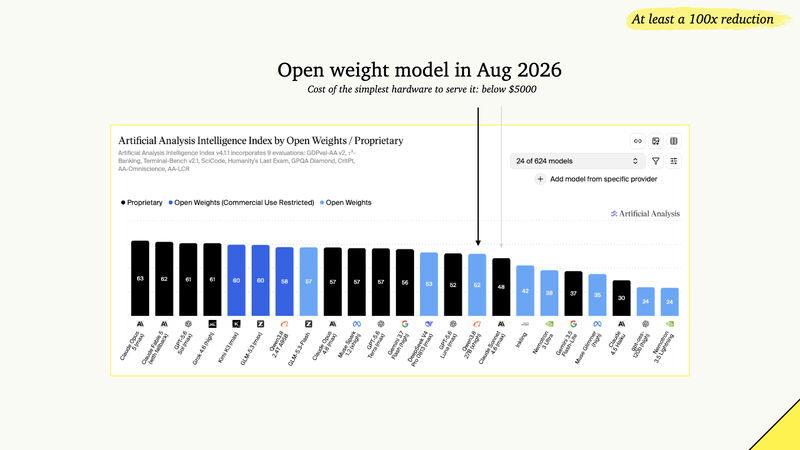
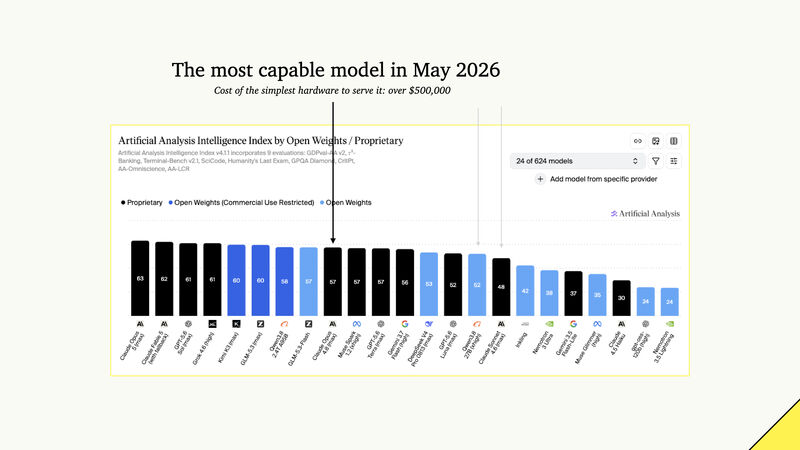
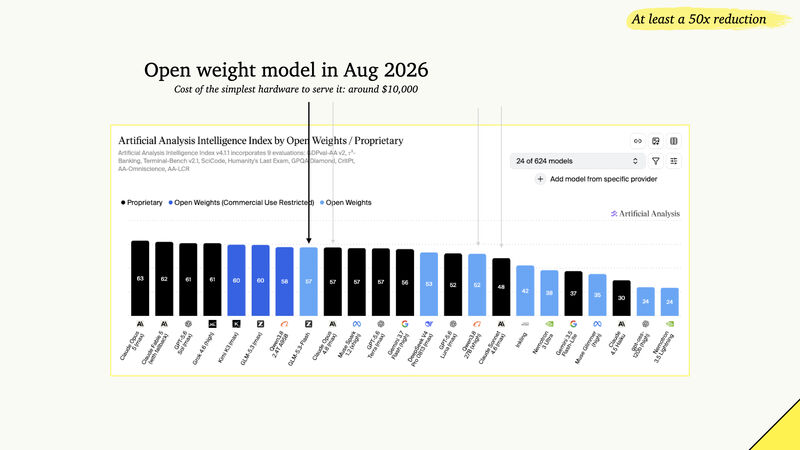
We can now own capabilities equal to the best model from 6 months ago for $5000 and capabilities equal to the best model from 3 months ago for $10000.
Another way to look at this is: OpenAI has 3 frontier models right now Sol, Terra, and Luna. We can now run an open-weight model equal to Terra on hardware we control for $10000 and a model equal to Luna for $5000.
That’s a 100x drop in the cost of owning intelligence in six months, and a 50x drop in three months.
This pricing pressure from the open-weight ecosystem is also affecting proprietary model providers: OpenAI recently cut Luna’s price by 80% and Terra’s by 20%.
In my last couple of posts I talked about the first order effects of Qwen3.8-27b and GLM-5.3-Flash. Their second-order effects are equally interesting.
Everyone is underestimating parallelism
Most discourse is still focused too much on the abilities of an individual model or agent. But with 100x cheaper intelligence, it's interesting to consider what is now possible when you can run 100 Opus 4.6-level agents for the same price.
There is also a much larger supply of lower-end GPU machines in the world than high-end ones, so I expect these costs to keep falling. Open-weight model progress is showing no signs of slowing down either.
I wonder what is possible now that we can cheaply run thousands of Opus 4.6-level agents on hard problems in scientific research, cybersecurity, software engineering, and other complex domains.