This is the autonomous feedback loop that runs for every slice of functionality Fluent, my open-source software factory, builds:
Writer → Tester → Parallel Reviewers ↺
↺ Review findings return to the Writer for another round.
In each round, multiple specialized Reviewer agents review the code produced by a Writer agent. There is an Architecture Reviewer, a Documentation Reviewer, a Security Reviewer, etc. These reviewers use human-authored and learnt expertise to give feedback to the Writer agent on how it should improve its proposed code change.
The rounds continue until all the reviewers are satisfied with the quality of the code.
Fluent's Security Reviewer can be configured to spawn Prover agents to gather proof of suspected vulnerabilities. Each Prover writes and runs a test against the actual built code to check whether the suspected vulnerability can actually be exploited.
For example, a Reviewer identifies a possible authorization bug. A Prover creates two test users and writes an end-to-end test showing that one can access the other’s private data. The finding now comes with a reproducible demonstration. Once the Writer fixes the bug, that test stays in the suite to catch the vulnerability if a later change reintroduces it.
This approach can quickly involve tens of agents per round, with several rounds to build a slice of functionality. Model costs add up across all those reviews and proof attempts.
That’s why the recent sharp fall in the cost of operating highly capable open-weight models is very exciting. DeepSeek V4.1 Flash, released a few days ago, is a great example.
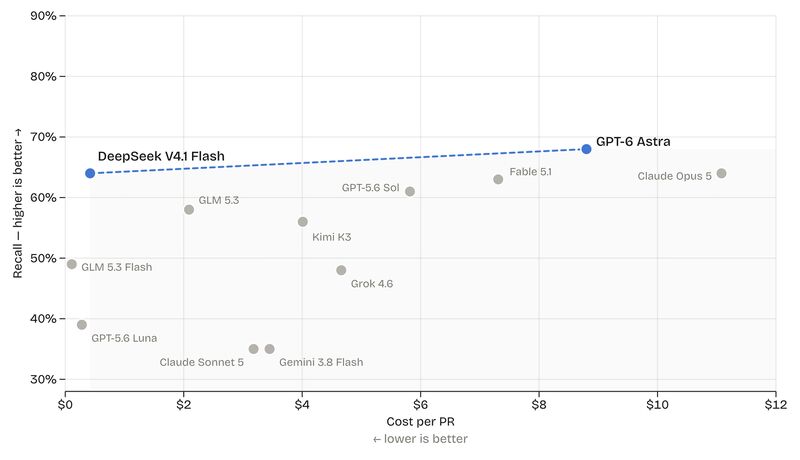
Dam Secure recently published a benchmark (see image) comparing how various frontier models perform when tasked with finding planted security vulnerabilities in code repos. They observed that GPT-6 Astra found 68% of planted vulnerabilities in their test set at $8.80 per review. DeepSeek V4.1 Flash found 64% of planted vulnerabilities at $0.42 per review.
That 21-fold cost advantage lets a software factory invest more effort in reviewing and verifying every change. Within the same budget, it can run more specialized reviews, investigate more suspicious cases, and complete additional rounds of correction.
This may sound counterintuitive given concerns about coding agents producing “slop,” but I expect software factories to raise the baseline of software quality and security. As agent intelligence gets cheaper, we can afford to be far more rigorous about assessing the security and quality of products we ship.